
Sand Tray Therapy for Stuck Words
When people think about therapy, they often picture the old Freudian image: lying on a couch and beginning the first session by answering the question, “Can you tell me about your parents?” While Sigmund Freud believed that was helpful more than a hundred years ago, modern mental health therapy has discovered that the best place to begin is often the present. The present is the part of the story we actually know, not just the ever-evolving story we have told ourselves about the past. So how do we bring the present to life without simply pulling out a list of complaints? Sand tray therapy is a good place to start.
When a client comes into my therapy room, one of the first things she notices is a shelf full of objects. I step back and let her choose what stands out. Over the years, I have collected many items. Some are obvious, like Polly Pockets, toy cars, Happy Meal toys, and things you might expect to find in a toy box. But what often opens the door to deeper understanding are the more unusual pieces: small trophies, dragons, cocktail glasses, food, slot machines, and other unexpected objects. In essence, these are tools. Their purpose is to trigger memories, both recent and distant, and to help describe feelings when there are no words.
That is where the process often begins to deepen.
It’s amazing what happens when a client finds an item that brings emotions, thoughts, or memories to mind. In those first moments, a story begins to unfold. Some clients find every prop and actor for their autobiography, while others may find only one artifact tied to a lost memory. Either way, what appears in the tray often says more than words ever could. This is the bittersweetness of truth. What rises to the surface is not always loud, but it is often revealing.
As the tray takes shape, the client begins to do more than notice objects. She begins to interact with the story they are telling.
At this point, the client walks me through her world. Together, we sort out thoughts that need more clarity, replace items in the tray with something that fits better, or add a detail that has just been remembered. This kind of editing matters because it is tangible. The client can see it, touch it, and change it. In that process, she often begins to regain a sense of agency. She starts to understand the tools she has, the resources available to help her, and the actual size of the monsters that scare her.
Recognizing Help Is Only the Beginning
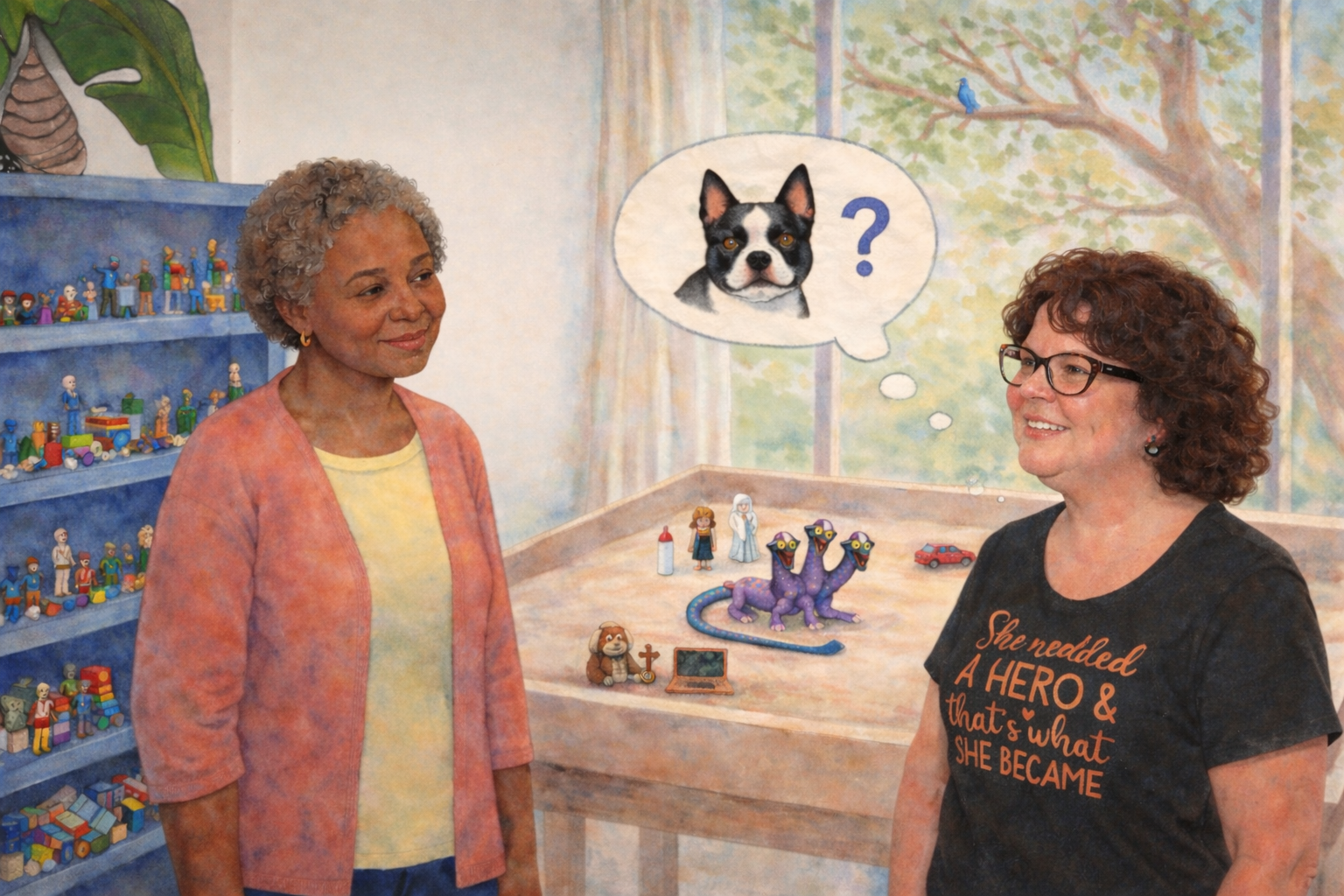
Sometimes a client begins to see resources in the tray that she had not fully noticed before. It may be a figure that represents a trusted friend, a steady spouse, a place of safety, or even a part of herself that has been stronger than she realized. But seeing a resource and using it in real life are not always the same thing. A woman may know help is available and still struggle to ask for it. She may understand that a boundary is needed and still feel guilty setting one. She may realize she is not alone and still hesitate to lean on the people who care about her. Recognition is often the first step, not the last. The tray helps make that gap visible. It allows a client to see not only what is available to her, but also what makes it difficult to trust, receive, or use.
Some Monsters Are Not One Thing

Not every monster in the tray stands alone. Sometimes what looks like one fear is actually several hurts, beliefs, or memories attached to each other. A woman may think she is only afraid of conflict, but as the story unfolds she begins to see that conflict is tied to rejection, abandonment, or an old fear of being misunderstood. Another woman may believe she is simply angry, only to realize that grief has been sitting underneath that anger the whole time. This is part of what makes sand tray therapy so helpful. It allows a client to see that what feels large and overwhelming may not be one thing at all. It may be a layered story, with one wound wrapped around another. When that becomes visible, she is beginning to name what has felt tangled for a long time
.
Learning What Is Yours to Carry

One of the hardest truths a client may face in the tray is that clarity does not create control. A woman may begin to understand a relationship, a conflict, or a painful pattern more clearly, but that does not mean she can make someone else change. She cannot force another person to be honest, trustworthy, or willing to change. What she can begin to see is what belongs to her and what does not. A woman may realize she has spent years trying to manage someone else’s reactions, hold together a strained relationship, or carry guilt that was never fully hers to begin with. That realization can be painful, but it can also be freeing. The tray helps make those boundaries visible. It allows a client to see where her responsibility ends, where another person’s begins, and what kind of agency she still has inside the story.
Sand tray therapy does not require a client to have the right words on day one. It offers another way to begin telling the truth. And when something that has felt tangled for a long time finally starts to take shape, that can be the beginning of hope.
If you have struggled to put words around what you feel, sand tray therapy may offer a place to begin. Schedule a consultation.